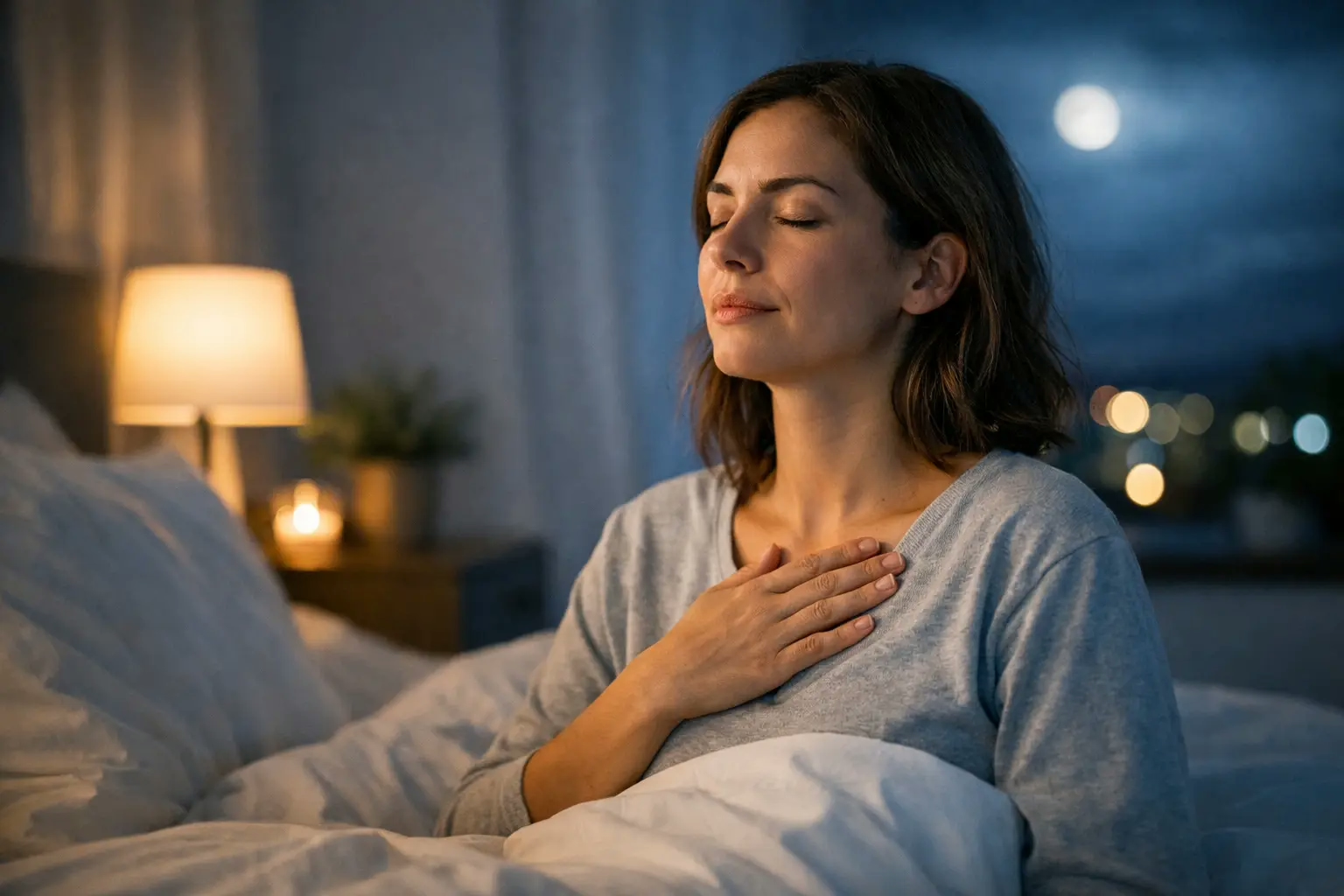
It’s 2:17. The body is tired, but the mind has switched back on without warning. Your heart is beating a little too fast, your thoughts are racing, and the more you want to sleep, the more tension you feel. In such moments, the Night Anxiety Breath can become a real anchor. Not a magic trick, but a simple way of signalling to the nervous system that it can relax again.
The night often amplifies what has been contained during the day. Silence brings up worries, undigested emotions and accumulated tensions. When anxiety arises at bedtime or in the middle of the night, the first reaction is often to fight. We tense up, get impatient, watch the clock. Yet it’s precisely this power struggle that keeps us alert.
Breathing consciously is the way out of this spiral. Breathing is one of the few direct bridges between the body and the inner state. By modifying the breathing rhythm, we influence the level of activation of the nervous system. It’s concrete, immediate and deeply regulating when done gently.
Why the night triggers so much excitement
Nocturnal anxiety isn’t just « in your head ». It’s experienced throughout the body. High, rapid or blocked breathing sends a message of urgency. The brain interprets this signal as a potential threat, even if there is no real danger in the room.
Fatigue also plays a role. At the end of the day, mental resources diminish, making it harder to put anxious thoughts at bay. For some people, the night becomes the only time when the body finally starts to speak. What has been held, controlled or postponed for hours then seeks a way out.
That’s why a breathing practice isn’t just about « making you sleep ». Above all, it helps to create inner security. And when the body feels secure, sleep can return more naturally.
Which breath for night-time anxiety?
The best breathing for nocturnal anxiety is often the simplest. At night, the nervous system doesn’t need intense technique. It needs a slow, reassuring, predictable rhythm. The aim is not to force a big inhalation, but to let the exhalation become a little longer than the inhalation.
This slight lengthening of the exhalation promotes relaxation. It tells the body that it can leave alertness and return to a state of rest. It’s a particularly useful approach if you wake up with a feeling of a lump in your stomach, chest tension or inner agitation for no clear reason.
Breathing 4-6, gentle and accessible
Inhale through the nose for 4 beats, then exhale slowly for 6 beats. Don’t inflate at all costs, and don’t try to perform. If 4 and 6 seem too long, start with 3 and 4. What counts is the feeling of fluidity.
Do this for 2 to 5 minutes. The body doesn’t need any more than that to start going down. If thoughts come, it’s not a failure. Simply return to the count and the passage of air.
Pause breathing is not always appropriate
Some methods recommend breath-holding. They may be useful in other contexts, but in the case of nocturnal anxiety, they are not suitable for everyone. For some sensitive people, holding air actually increases the feeling of lack or control.
At night, it’s best to focus on continuity. A freely flowing breath is often more reassuring than an overly structured or ambitious exercise.
How to practice when you’re already in the throes of anxiety
When anxiety sets in, there’s no point in trying to breathe « perfectly ». The first step is to reduce the pressure. You can put one hand on your belly and the other on your chest, simply to feel where the breath is today. Nothing to correct first. Just observe.
Then let the exhalation empty out a little more completely, as if you were blowing through an invisible straw. The inhalation will come on its own. This detail makes a big difference, as anxious people often seek to « take in more air », whereas true relaxation often begins with letting it out.
If you’re lying down and this is making the oppression worse, straighten your torso slightly with a pillow, or sit on the edge of the bed for a few moments. The body sometimes needs a more open posture to feel that breathing becomes possible again.
A simple 5-minute sequence
Close your eyes if it soothes you. Relax your jaw, shoulders and stomach. Inhale through the nose on 4 counts. Exhale on 6 beats. Repeat for 10 cycles. Then drop the count and simply feel the movement of the air.
At the end, don’t immediately test whether you’ve « calmed down enough ». This self-monitoring recreates tension. Stay in the feeling for a few moments, even if sleep doesn’t come immediately.
What really helps the body let go
Breathing works best when it’s part of a coherent environment. If you breathe slowly but scroll through your messages, if the light is bright or if you ruminate in parallel, the nervous system receives contradictory signals.
Creating an atmosphere of security before bedtime changes the quality of breath. Soft light, a slower pace in the evening, less mental stimulation, time to return to oneself. It’s not a question of perfection, but of transition. The body needs to feel that the day is really closing.
For some people, nocturnal anxiety is a one-off event. For others, it comes back in cycles, especially during periods of emotional overload, life change, bereavement, professional tension or deep fatigue. In such cases, breathing remains a valuable tool, but it can be integrated into a more holistic approach.
When breathing alone is not enough
Sometimes the breath helps in the moment, without treating the whole root of the problem. This is often the case when nocturnal anxiety is fuelled by chronic stress, long-held emotions, or a body that remains hypervigilant even at rest.
In this context, breathing is not just a management tool. It can become a doorway to inner exploration. In a session, in a reassuring setting, breathing work often enables us to encounter what manifests itself at night in the form of oppression, insomnia or diffuse fear. It’s more than just a search for immediate calm. It’s a way of restoring a deeper connection with oneself, with one’s feelings, with one’s real needs.
This is also where a holistic approach comes into its own. Breath soothes, but it also reveals. It brings to light the places in the body where we hold back, where we control, where we exhaust ourselves. And this awareness often paves the way for more lasting transformation.
Breathing for nocturnal anxiety: common mistakes
The first mistake is to breathe too hard. When you’re desperate to calm down, you amplify the movement, overfilling it, almost creating an effort. But calm rarely comes from intensity. It’s born of slowness, regularity and permission.
The second mistake is trying to achieve immediate results. Some nights, the body responds quickly. Other times, it takes longer. If you use breathing as a permanent test – is it working, am I sleeping now, why isn’t it working – you maintain a form of vigilance.
The third mistake is to ignore what the night is trying to show. If nocturnal anxiety recurs frequently, it deserves to be listened to. Breath calms, yes. But it can also invite you to take a deeper look at your load level, your limits, your need for support or refocusing.
Rediscovering a more peaceful relationship with the night
It’s not about controlling your nights perfectly. It’s about rebuilding a relationship of trust with your body. The more you offer your body a stable, benevolent breath, the more it learns that it doesn’t have to defend itself against rest.
Over time, breathing becomes more than a technique. It becomes an inner reference point. A gesture of presence. A way of telling ourselves, in the midst of agitation, that we can return here, now, to a slightly calmer space.
If you experience these anxious awakenings repeatedly, start small. Two minutes tonight. Three tomorrow. And let the breath do what it’s always done when given space: gently bring you back into balance.