
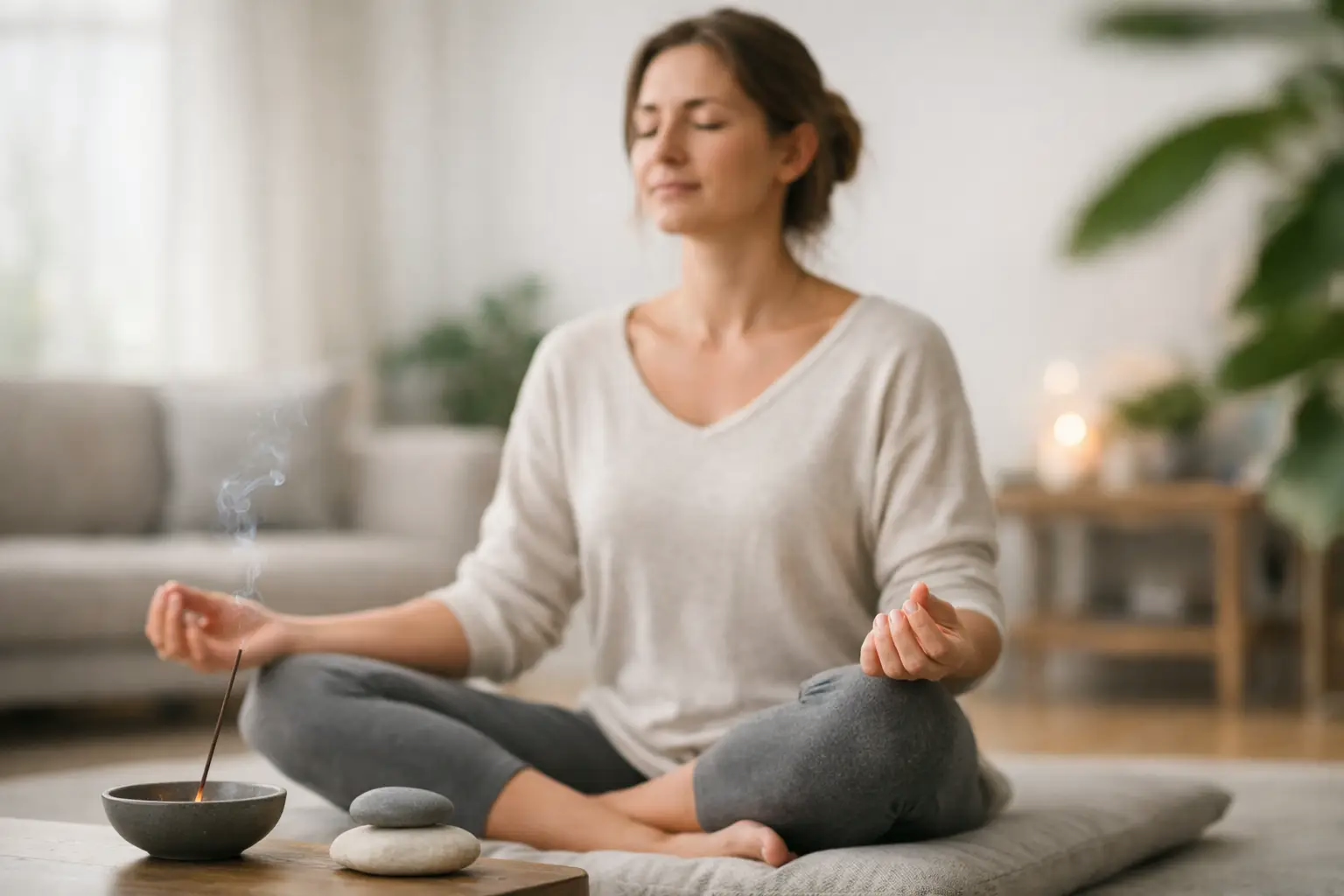
There are days when everything just seems to hang inside us. A conversation that goes round and round, nervous fatigue that just won’t go away, a feeling of tension in the chest or stomach for no clear reason. This is often where letting go meditation becomes invaluable – not to erase everything, but to create an inner space where body, breath and mind can finally loosen up.
Letting go doesn’t mean giving up, denying what you’re feeling or becoming indifferent. It’s a more subtle movement. It’s about ceasing to hold on to what’s heavy, fighting less against what’s already there, and returning to a gentler presence towards ourselves. For many, this process doesn’t begin in the head. It begins in the body.
Why letting go is so resistant
When we feel stressed, overstretched or emotionally tense, the nervous system goes into overdrive. The mind seeks to control, anticipate and analyze. It’s an attempt to protect ourselves. The problem is that the more we want to force calm, the more we sometimes maintain our inner contraction.
That’s why so many people say they can’t meditate. In reality, they often try to meditate against their own agitation, instead of meditating with what is present. But letting go is rarely born of constraint. It emerges when we feel safe enough to let go, even a little.
Meditation offers just that. A simple, stable framework where you have nothing to prove. You don’t have to empty yourself, you don’t have to be perfectly serene. Just slow down enough to hear what needs to be welcomed.
Meditation for letting go starts with the breath
Breath is a bridge. It links the physical body, the emotional state and mental activity. When the breath is short, high, restrained, we often feel rushed, closed or scattered. When it becomes more conscious, fuller and more regular, the body receives a clear message – it can release some of its alertness.
This is where letting go meditation becomes particularly powerful. It’s not just about concentration. It also involves gentle regulation of the nervous system. Just a few minutes of conscious breathing can change the quality of your presence.
This doesn’t mean that everyone has to practice the same way. Some people calm down with silent attention to the breath. Others need a guided voice, an anchoring in sensations, or a more structured breathing rhythm. There is no single right method. There is the practice that allows you, at that moment, to feel accompanied internally.
How to practice a meditation to let go
Start by choosing a time when you won’t be interrupted. It doesn’t have to be thirty minutes. Five to ten minutes may be enough, especially if you tend to put off such breaks. Sit or lie down in a simple position, without trying to achieve perfect posture.
Close your eyes if you like, or keep your gaze gently in front of you. First, become aware of the points of contact with the floor, chair or bed. Feel the weight of your body. This may seem a discreet step, but it’s one that helps you get out of mental overactivity.
Then turn your attention to your breathing, without wanting to change it right away. Observe the air coming in, the air going out. The belly moving, the ribcage opening, then closing. After a few cycles, you can lengthen the exhalation slightly. For example, inhale on four beats, exhale on six. Nothing forced. Just a slightly longer breath on the way out to invite relaxation.
As thoughts arise, notice them without getting hung up on them. If an emotion arises, don’t immediately try to interpret it. Return to the breath, to the sensations of the body, to contact with the moment. You can also repeat a simple phrase such as « I release », « I open », or « I can lay down ».
It’s not about having a spectacular experience. It’s about creating a different relationship with what’s passing through you. Softer. More breathable. More alive.
When emotions rise during practice
Sometimes, as soon as you slow down, tears, annoyance, sadness or deep fatigue emerge. This isn’t necessarily a sign that meditation isn’t working for you. It may simply show that the inner space is opening up, and that what was being held is beginning to present itself.
In this case, gentleness is essential. If the intensity is bearable, keep breathing, witnessing what’s happening. If it’s too strong, open your eyes, move slightly and return to your surroundings. Letting go is not about being overwhelmed. It’s also about respecting your own rhythm.
This is where support can make a real difference, especially when there is chronic stress, old blockages or a heavy emotional burden. A supportive framework allows you to let go without losing your sense of security.
What practice changes in everyday life
The effects of meditation are not limited to the moment you close your eyes. Over time, something shifts in the way we experience situations. We react more slowly. You spot signals of overload earlier. You can feel when your body is tense, when your breath is blocked, when your mind starts to squeeze again.
This change may seem modest at first. Yet it transforms so much. Letting go becomes less an abstract idea than an embodied ability. We learn to make room instead of accumulating. To feel without fully identifying. To go through an emotion without getting trapped in it.
There’s also a more discreet, but profoundly restorative benefit – reconnection with oneself. When we’ve been living in tension for a long time, we sometimes end up no longer clearly feeling our needs, our limits or our inner truth. Meditation gradually restores this listening. It restores presence where there was only agitation.
Limits to be aware of
Meditation is not a magic wand. It can soothe, support and enlighten, but it doesn’t replace everything. In certain periods, complementary work is necessary – guided breathing, therapeutic support, body practice, real rest, concrete lifestyle adjustments.
Sometimes, simple immobility is not for everyone, especially at the beginning. Some people find it easier to let go through movement, active breathing or voice. For them, sitting meditation becomes more accessible after an initial liberation of the body. At Just Breathe Geneva, this reality is at the heart of our approach – lasting calm comes more naturally when we first help the nervous system out of overload.
Setting up a simple, sustainable practice
More often than not, it’s not intensity that changes lives, but regularity. A short practice, repeated with honesty, has more impact than a long session done once and then abandoned. Seven minutes every morning is better than the occasional hour that feels like a constraint.
Choose a realistic anchor. After waking up, before going to sleep, after a day’s work, or just before an important appointment. Associate this moment with a simple cue – sit down, place a hand on your heart or belly, breathe more slowly, feel your body. By repeating this ritual, you teach your body a new path back to calm.
If you feel your mind going off in all directions, don’t consider it a failure. In fact, it’s often the starting point. Every return to the breath is a gesture of letting go. Every time you notice the tension without judging yourself, something softens.
Meditation for letting go and inner transformation
At a certain point, practice is no longer just about relaxing. It becomes a space of truth. Here, we encounter our resistances, fears and attachments, but also a broader, more stable quality of presence, less governed by urgency. This is where meditation becomes truly transformative.
Letting go doesn’t mean losing control of your life. It means ceasing to cling to everything that doesn’t depend on you. It’s about letting go of what needs to flow. It’s about rediscovering a form of trust, not naive, but profound. It’s the kind of trust that arises when the breath becomes a support and inner space begins to breathe again.
If you’re looking to move toward more peace, just start. Just sit back. Take a breath. Listen to what within you requires less effort and more presence. Sometimes, the first real letting go starts there, in a few minutes of inhabited silence.